How to Rank Higher on Google Maps: 15 Proven Tips to Improve Local Rankings in 2027
Learn how to rank higher on Google Maps with proven Google Business Profile optimization and local SEO strategies. Discover 15 actionable tips to improve visibility, attract more customers, and dominate local search results in 2027.

If your business isn’t appearing on Google Maps when customers search for services in your area, you’re losing potential calls, leads, website visits, and walk-in customers every single day.
The good news is that ranking higher on Google Maps isn’t random.
Google uses hundreds of signals to determine which businesses appear in local search results and the coveted “Local 3-Pack” — the three businesses that appear at the top of Google Maps results.
Businesses that appear in these top positions often receive the majority of local clicks, calls, direction requests, and website visits.
Whether you’re a restaurant owner, dentist, salon, gym, real estate consultant, repair service, or local retailer, improving your Google Maps rankings can have a direct impact on your revenue.
In this guide, you’ll learn exactly how Google Maps rankings work and the proven strategies local businesses use to improve visibility and attract more customers.
How Google Maps Ranking Works
Before trying to improve your rankings, it’s important to understand how Google decides which businesses to show.
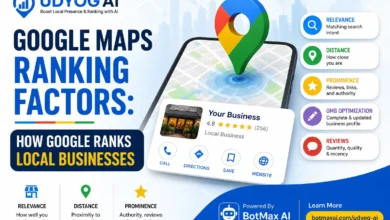
Google primarily uses three major factors when ranking businesses on Google Maps:
1. Relevance
Relevance refers to how well your business matches what a customer is searching for.
For example, if someone searches for:
- Best dentist near me
- Orthodontist in Mumbai
- Emergency dental clinic
Google will try to show businesses whose profiles clearly indicate that they provide those services.
Businesses with complete and detailed profiles generally have a better chance of appearing for relevant searches.
Factors affecting relevance include:
- Business category
- Services listed
- Products listed
- Business description
- Website content
- Reviews mentioning your services
- Google Posts
- Photos and updates
The better Google understands your business, the easier it becomes to match you with potential customers.
2. Distance
Distance refers to how close your business is to the searcher or the location mentioned in the search query.
For example:
- “Cafe near me”
- “Gym in Indiranagar”
- “Lawyer in Delhi”
If a customer searches from South Delhi, businesses located nearby will generally receive preference over businesses located 20 kilometers away.
Unlike other ranking factors, distance cannot be directly controlled.
However, businesses can improve their chances of appearing across a wider area by:
- Defining service areas correctly
- Building local authority signals
- Creating location-specific website pages
- Earning reviews from customers across their service region
3. Prominence
Prominence refers to how popular, trustworthy, and authoritative Google considers your business.
This is often the biggest difference between businesses ranking in position #2 and businesses ranking in position #15.
Prominence signals include:
- Number of reviews
- Review quality
- Review velocity
- Business citations
- Website authority
- Local backlinks
- Google Business activity
- Brand searches
- Media mentions
- Customer engagement
A business with 500 genuine reviews, regular updates, and strong local authority will generally outperform a business with an inactive profile and only a handful of reviews.
Quick Google Maps Ranking Checklist
Before diving deeper, ensure your business has completed these essentials:
✔ Google Business Profile claimed and verified
✔ Correct business name, address, and phone number
✔ Primary category selected correctly
✔ Secondary categories added where relevant
✔ Business description completed
✔ Services and products added
✔ Opening hours updated
✔ High-quality photos uploaded
✔ Reviews actively collected
✔ Every review receives a response
✔ Website linked and optimized for local SEO
✔ Google Posts published regularly
If you’ve missed several items on this checklist, fixing them alone can significantly improve your visibility on Google Maps.
1. Claim and Verify Your Google Business Profile
This is the foundation of Google Maps SEO.
If your business profile is not verified, Google has limited trust in the information associated with your listing, which can impact visibility.
Verification confirms that:
- Your business is legitimate.
- You operate at the listed location.
- You have authority to manage the profile.
After verification, you’ll gain access to important features such as:
- Review management
- Posts
- Products and services
- Business updates
- Messaging
- Performance insights
Many businesses surprisingly stop after verification and never optimize their profile further.
Verification is not optimization.
It is simply the first step.
2. Choose the Right Primary Category
Your primary category is one of the strongest local ranking signals.
Many businesses make the mistake of selecting broad categories that don’t accurately describe their primary service.
For example:
Bad Example:
- Business: Dental Implant Specialist
- Category: Doctor
Better Example:
- Business: Dental Implant Specialist
- Category: Dental Clinic
The more accurately your category matches customer intent, the easier it becomes for Google to understand when your business should appear in search results.
After selecting your primary category, add relevant secondary categories to increase visibility for additional services.
For example, a dental clinic may also include:
- Cosmetic Dentist
- Pediatric Dentist
- Emergency Dental Service
- Orthodontist
Choosing categories strategically can significantly improve your visibility for multiple search terms without requiring additional advertising.
3. Complete Every Section of Your Profile
Incomplete profiles almost always underperform complete profiles.
Think of your Google Business Profile as your local business website inside Google’s ecosystem.
Businesses should complete:
- Business description
- Services
- Products
- Appointment links
- Website URL
- Phone number
- Service areas
- Business hours
- Special holiday hours
- Attributes
- FAQs
- Opening date
The more information Google has about your business, the better it can match your profile with customer searches.
A fully optimized profile sends stronger relevance signals and improves customer trust at the same time.
4. Maintain Consistent Business Information Everywhere
Google trusts businesses that have consistent information across the internet.
Your business name, address, and phone number (commonly known as NAP) should be identical across:
- Your website
- Google Business Profile
- Facebook Page
- Business directories
- Industry-specific directories
- Local listing websites
Even small differences can create confusion.
For example:
❌ ABC Dental Clinic Pvt Ltd
❌ ABC Dental Clinic
❌ ABC Dental Care Center
While these may look similar to humans, search engines can sometimes treat them as separate businesses.
The same applies to addresses and phone numbers.
Consistency strengthens trust signals and improves local rankings over time.
5. Collect More Genuine Customer Reviews
Reviews are one of the strongest Google Maps ranking signals.
Businesses with a healthy flow of recent, authentic reviews tend to perform better in local search results than businesses with very few reviews.
However, quantity alone is not enough.
Google evaluates:
- Total number of reviews
- Review quality
- Review recency
- Review frequency
- Customer engagement
- Keywords naturally mentioned in reviews
For example, this review provides stronger context than a simple five-star rating:
“Excellent dental implant treatment in Delhi. The doctor explained everything clearly and the staff was very supportive.”
This helps Google better understand the services your business provides.
Best practices for review collection:
- Ask every customer for feedback.
- Send review requests within 24 hours of service completion.
- Use QR codes in your store.
- Include review links in WhatsApp or SMS messages.
- Train staff to ask for reviews naturally.
Avoid:
- Buying fake reviews.
- Offering incentives for positive reviews.
- Asking employees to review the business.
- Posting reviews from the same network or device repeatedly.
These tactics can lead to profile suspensions or ranking losses.
6. Respond to Every Review
Many businesses focus on collecting reviews but ignore replying to them.
Responding to reviews shows Google that your business is active and engaged with customers.
It also improves trust among potential customers reading your profile.
Good responses should:
- Thank the customer.
- Mention the service provided when appropriate.
- Stay professional and personalized.
- Encourage future visits.
Example:
“Thank you for choosing us for your dental treatment. We’re happy to hear that you had a positive experience with our team and look forward to serving you again.”
Avoid copying the same response for every customer.
Unique responses create stronger engagement signals and improve customer trust.
Negative reviews should also receive professional responses.
A well-handled negative review can often improve customer perception more than a perfect five-star profile.
7. Upload High-Quality Photos and Videos Regularly
Visual content plays a major role in local search performance.
Businesses that regularly upload fresh photos often receive higher engagement in terms of:
- Calls
- Direction requests
- Website visits
- Profile interactions
Recommended photo categories include:
- Exterior photos
- Interior photos
- Team photos
- Products
- Services
- Customer experience
- Before-and-after examples
- Events and promotions
Video content can be even more powerful because it increases user engagement and trust.
A simple 20-second walkthrough video can often outperform dozens of static images.
Aim to upload new visual content every month.
8. Publish Google Business Profile Posts Weekly
Google Business Profile posts are one of the most underutilized local SEO opportunities.
Regular posting signals that your business is active and operating normally.
You can publish:
- Offers
- Events
- Product launches
- Announcements
- Seasonal promotions
- Educational content
- Tips and guides
Examples include:
- “5 Tips to Protect Your Teeth During Summer”
- “Monsoon Car Maintenance Checklist”
- “How to Prepare for Your First Property Consultation”
Posting consistently helps improve profile freshness and customer engagement.
Many local SEO professionals recommend publishing at least one post per week.
9. Add Services and Products to Your Profile
Many businesses leave these sections empty.
This is a missed opportunity.
Adding services and products helps Google understand:
- What you offer
- Which searches you should appear for
- How your business differs from competitors
For example, a salon could include:
- Haircut
- Hair Coloring
- Keratin Treatment
- Bridal Makeup
- Facial Treatments
Each service creates additional relevance signals for local searches.
Include clear descriptions and pricing whenever possible.
10. Optimize Your Website for Local SEO
Your Google Business Profile and website work together.
A weak website can limit your Maps rankings.
Key local SEO improvements include:
- Location pages
- Service pages
- Fast loading speed
- Mobile optimization
- Internal linking
- Local keywords
- Contact information in footer
- Embedded Google Map
- Local business schema markup
For example, instead of targeting:
“Dental Services”
Target:
“Dental Clinic in South Delhi”
Location-specific pages help businesses rank for nearby searches more effectively.
11. Build Local Citations
A citation is any online mention of your business information.
Examples include:
- Local directories
- Industry directories
- Chamber of commerce websites
- Business associations
- Local newspapers
- Community websites
Citations reinforce your business legitimacy and improve local trust signals.
Focus on quality rather than quantity.
Ten strong local citations are usually more valuable than hundreds of low-quality listings.
12. Earn Local Backlinks
Backlinks remain an important ranking factor for both traditional SEO and local SEO.
Examples of local backlink opportunities include:
- Local news websites
- Community events
- Sponsorships
- Industry associations
- Business partnerships
- Local blogs
For example:
A restaurant sponsoring a local sports event may receive coverage and a backlink from the event website.
These local signals strengthen prominence and improve Google Maps visibility.
13. Improve Customer Engagement Signals
Google pays attention to how customers interact with your profile.
Positive engagement signals include:
- Calls
- Website clicks
- Direction requests
- Photo views
- Review interactions
- Message interactions
Businesses that attract strong engagement often maintain higher rankings over time.
This is why having attractive photos, strong reviews, and clear information is important.
14. Monitor Your Performance Data
What gets measured gets improved.
Track important metrics such as:
- Calls
- Website visits
- Direction requests
- Search impressions
- Review growth
- Photo views
- Ranking positions
Identify trends every month and adjust your strategy accordingly.
Local SEO is not a one-time activity.
It is an ongoing optimization process.
15. Stay Active Every Month
One of the biggest differences between businesses ranking in the top three positions and businesses ranking on page two is consistency.
Winning businesses continue to:
- Publish posts
- Collect reviews
- Upload photos
- Reply to customers
- Update services
- Monitor rankings
- Improve their website
Google prefers active businesses because active businesses generally provide better customer experiences.
Consistency compounds over time.
Small improvements made every week can create significant ranking gains over several months.
Common Mistakes That Hurt Your Google Maps Rankings
Many businesses unknowingly damage their local rankings by using outdated or risky tactics.
Avoid these common mistakes:
1. Keyword Stuffing Your Business Name
Adding extra keywords to your business name may provide temporary improvements but can violate Google’s guidelines.
Example:
❌ Sharma Dental Clinic | Best Dentist in Delhi | Dental Implant Specialist | Root Canal Expert
Instead, use your real business name exactly as it appears in the real world.
✔ Sharma Dental Clinic
2. Buying Fake Reviews
Fake reviews are becoming easier for Google to detect.
Businesses using purchased reviews often experience:
- Review removals
- Ranking drops
- Profile restrictions
- Business profile suspensions
Focus on collecting genuine customer feedback instead.
3. Creating Duplicate Listings
Multiple listings for the same business location can confuse Google and dilute ranking signals.
Always maintain a single primary listing for each legitimate business location.
4. Using Incorrect Categories
Choosing the wrong primary category is one of the most common local SEO mistakes.
The wrong category can prevent your business from appearing for valuable searches.
Review your categories regularly and update them when necessary.
5. Ignoring Negative Reviews
Unanswered negative reviews can reduce customer trust and engagement.
Respond professionally, address concerns, and demonstrate your commitment to customer satisfaction.
6. Leaving Your Profile Inactive
Profiles that haven’t received updates for months often struggle to compete with active businesses.
Regular activity helps maintain visibility and engagement.
How Long Does It Take to Rank Higher on Google Maps?
This is one of the most common questions business owners ask.
The answer depends on:
- Competition in your industry
- Competition in your location
- Current profile strength
- Review count
- Website authority
- Business activity
Typical timelines are:
Low Competition Markets
2 to 6 weeks
Moderate Competition Markets
2 to 4 months
Highly Competitive Markets
4 to 12 months or longer
Businesses in industries such as dentistry, legal services, real estate, and home services often face stronger competition and longer ranking timelines.
Google Maps SEO should be treated as a long-term business asset rather than a short-term campaign.
Frequently Asked Questions
How do I rank higher on Google Maps quickly?
The fastest improvements usually come from:
- Completing your Google Business Profile.
- Collecting new customer reviews.
- Replying to existing reviews.
- Uploading fresh photos.
- Publishing weekly posts.
These actions often generate noticeable improvements within a few weeks.
Do Google reviews improve Google Maps rankings?
Yes.
Reviews are one of the strongest local ranking signals.
Google evaluates both the quantity and quality of reviews, as well as how recently they were received.
How many reviews do I need to rank higher?
There is no fixed number.
The goal is not to have the most reviews overall but to have more high-quality and recent reviews than competitors in your market.
In some locations, 30 reviews may be enough to compete.
In highly competitive industries, businesses may require hundreds or even thousands of reviews.
Does posting on Google Business Profile improve rankings?
While Google has never officially confirmed posts as a direct ranking factor, active profiles generally perform better than inactive ones.
Posts improve engagement and demonstrate business activity.
Can I pay Google to rank higher on Google Maps?
No.
Google Maps rankings are determined algorithmically.
Advertising through Google Ads can increase visibility through sponsored placements, but it does not directly improve organic Google Maps rankings.
Why is my business not showing on Google Maps?
Common reasons include:
- The profile is not verified.
- The business category is incorrect.
- The business was recently created.
- The profile was suspended.
- The business has very few trust signals.
- Competitors have stronger local authority.
What is the Google Local 3-Pack?
The Local 3-Pack refers to the three businesses displayed at the top of local search results before standard website listings.
These positions typically receive the highest percentage of clicks and customer interactions.
Is Google Maps SEO different from traditional SEO?
Yes.
Traditional SEO focuses on ranking websites in organic search results.
Google Maps SEO focuses on improving local visibility using business profiles, reviews, proximity, citations, and local authority signals.
However, both strategies support each other and work best when implemented together.
Final Thoughts
Ranking higher on Google Maps is not about finding shortcuts or exploiting the algorithm.
Businesses that consistently provide accurate information, collect genuine reviews, engage with customers, and stay active online usually outperform competitors over time.
Remember the three pillars of Google Maps rankings:
- Relevance
- Distance
- Prominence
You cannot control distance, but you can continuously improve relevance and prominence.
For most local businesses, the businesses appearing in the top three positions are not necessarily the largest businesses.
They are often simply the businesses that optimize better and remain more active than their competitors.
If you begin implementing the strategies outlined in this guide today, you can start building stronger local visibility, attracting more customers, and generating more calls, leads, and revenue from Google Maps.
Ready to Improve Your Google Maps Rankings?
Managing reviews, publishing posts, replying to customers, tracking performance, and optimizing your profile manually can become time-consuming as your business grows.
Tools like Udyog AI help local businesses automate many of these activities, including:
- AI-generated Google Business posts
- Review invitations
- AI review replies
- Profile optimization suggestions
- Ranking insights and performance reports
The businesses that consistently optimize their Google Business Profile are often the businesses that dominate local search results.
The best time to start improving your Google Maps rankings is today.