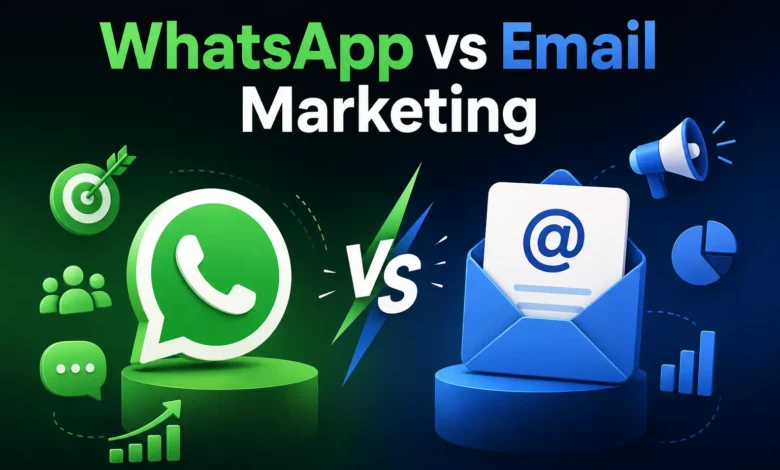
WhatsApp vs Email Marketing: Which One is Better for Business Growth?
Compare WhatsApp vs Email Marketing and discover which platform helps businesses improve engagement, customer communication, conversions, and sales growth.

Marketing has changed completely in the last few years.
Earlier, businesses mainly depended on emails, phone calls, and traditional advertisements to communicate with customers. Email marketing became one of the strongest digital marketing channels because it allowed brands to reach thousands of customers directly.
But customer behavior has changed.
Today, people expect instant replies, personalized communication, and faster solutions. Customers do not want to wait hours or days for a response. They prefer conversations that happen in real time.
This shift has made WhatsApp one of the fastest-growing channels for business communication.
But does that mean email marketing is no longer useful?
Not really.
Both WhatsApp marketing and email marketing have their own strengths. The real question is:
Which platform works better for customer engagement, conversions, and business growth?
In this article, we will compare WhatsApp vs email marketing based on communication, automation, personalization, customer experience, and sales performance.
What is WhatsApp Marketing?
WhatsApp marketing is a digital marketing strategy where businesses use WhatsApp to communicate with customers, promote products, automate conversations, and improve customer relationships.
Instead of sending traditional advertisements, businesses can create direct conversations with their customers.
Modern businesses use solutions like WhatsApp Business and WhatsApp Business API to manage customer communication at scale.
With WhatsApp marketing, businesses can:
- Send product updates
- Share offers and promotions
- Provide customer support
- Automate replies
- Generate leads
- Send order notifications
- Collect customer feedback
For example:
A customer interested in a product sends a WhatsApp message.
An automated chatbot instantly replies, answers questions, shares product information, collects customer details, and helps complete the purchase.
This makes WhatsApp not only a messaging platform but a complete sales and customer engagement channel.
What is Email Marketing?
Email marketing is a digital marketing method where businesses communicate with customers by sending emails.
Companies use email marketing for:
- Newsletters
- Product announcements
- Educational content
- Offers
- Customer updates
- Lead nurturing
Email marketing has been one of the most successful online marketing channels for many years.
It works especially well when businesses need to share detailed information.
For example:
A software company launching a new feature can send a detailed email explaining benefits, tutorials, and resources.
Email is professional, organized, and effective for long-term customer relationships.
However, with increasing competition in customer inboxes, businesses need stronger strategies to get attention.
WhatsApp vs Email Marketing: Complete Comparison
Both platforms help businesses communicate with customers, but they work differently.
Let’s compare them based on important factors.
1. Open Rate and Customer Attention
The first challenge in marketing is simple:
Will customers actually see your message?
WhatsApp messages appear directly inside the customer’s chat application. Since people check WhatsApp multiple times every day, businesses have a better chance of getting noticed.
Customers receive instant notifications, making communication faster.
Email works differently.
A customer inbox already contains:
- Promotional emails
- Newsletters
- Work emails
- Automated messages
Because of this competition, many emails remain unread or move into promotion folders.
For businesses that need instant attention, WhatsApp creates a stronger communication experience.
2. Customer Engagement
Modern customers do not just want information.
They want conversations.
This is where WhatsApp has a major advantage.
WhatsApp creates two-way communication.
Customers can:
- Ask questions
- Share requirements
- Send images
- Get instant responses
It feels like talking to a real person.
Email communication is usually slower and more formal.
Most email campaigns work as one-way communication where businesses send information and customers read it.
For interactive customer relationships, WhatsApp provides a more conversational experience.
3. Personalization Experience
Personalization is one of the most important parts of modern marketing.
Customers respond better when messages feel relevant.
WhatsApp creates a personal communication environment.
Example:
“Hi Rahul, your order has been shipped. Track your delivery here.”
This feels natural because it appears inside a personal chat.
Email marketing also supports personalization.
Businesses can personalize:
- Customer names
- Product suggestions
- Content recommendations
- Offers
Both platforms support personalization, but WhatsApp feels more direct and conversational.
4. Automation Capability
Automation helps businesses save time and manage more customers without increasing workload.
Both WhatsApp and email support automation.
Email automation examples:
- Welcome email sequences
- Weekly newsletters
- Customer education campaigns
- Follow-up emails
WhatsApp automation examples:
- Instant chatbot replies
- Lead qualification
- Appointment booking
- Product recommendations
- Customer support automation
Example:
Customer:
“What is your pricing?”
AI WhatsApp chatbot:
“Hello! Here are our pricing plans. Can you share your requirement so we can suggest the best option?”
This creates an instant sales conversation.
Email automation is excellent for nurturing customers, while WhatsApp automation is powerful for real-time engagement.
5. Sales Conversion
Every business wants more conversions.
The easier you make the buying journey, the higher your chances of conversion.
WhatsApp reduces customer steps.
A simple journey:
Customer message
↓
Instant conversation
↓
Question answered
↓
Purchase decision
Everything happens inside one chat.
Email usually has a longer journey:
Open email
↓
Read content
↓
Click link
↓
Visit website
↓
Take action
Because WhatsApp creates faster interactions, it works extremely well for businesses focused on quick conversions.
6. Customer Support Experience
Customer support plays an important role in business growth.
Slow support creates unhappy customers.
WhatsApp allows companies to provide faster support through:
- Live chat
- AI assistants
- Automated answers
- Conversation history
Customers can easily continue previous conversations.
Email support is better when businesses need:
- Detailed explanations
- Documents
- Formal communication
- Long technical discussions
For quick customer service, WhatsApp provides a smoother experience.
WhatsApp vs Email Marketing Comparison Table
| Feature | WhatsApp Marketing | Email Marketing |
|---|---|---|
| Communication | Conversational | Mostly formal |
| Speed | Instant | Slower |
| Engagement | High | Medium |
| Automation | Advanced chatbot automation | Email sequences |
| Personalization | Highly personal | Good |
| Customer Support | Fast conversations | Detailed support |
| Best For | Sales & engagement | Education & nurturing |
When Should Businesses Use WhatsApp Marketing?
WhatsApp marketing is best when businesses need fast communication and customer interaction.
It works great for:
- Ecommerce businesses
- Real estate companies
- Coaching institutes
- Healthcare services
- Travel agencies
- Financial services
- Local businesses
Common use cases:
- Lead generation
- Customer support
- Offers
- Booking reminders
- Sales follow-ups
When Should Businesses Use Email Marketing?
Email marketing is still valuable.
It works better for:
- Long-form content
- B2B communication
- Newsletters
- Reports
- Educational content
Businesses should not completely ignore email because it remains a strong relationship-building channel.
Should Businesses Use WhatsApp and Email Together?
The best strategy is not choosing WhatsApp or email.
The best strategy is combining both.
Example:
A customer discovers your brand
↓
Receives educational emails
↓
Shows buying interest
↓
Moves to WhatsApp conversation
↓
Gets instant support
↓
Completes purchase
Email builds relationships.
WhatsApp converts conversations into customers.
Future of Marketing: AI-Powered Conversations
The future of marketing is becoming more conversational.
Customers want brands that understand them and respond quickly.
With WhatsApp Business API, AI chatbots, and automation, companies can create smarter customer experiences.
Businesses adopting conversational marketing today will have a stronger advantage in the future.
Conclusion: WhatsApp vs Email Marketing — Which is Better?
Email marketing is not dead.
It is still powerful for education, professional communication, and long-term customer relationships.
But customer expectations have changed.
People want faster and more personalized communication.
WhatsApp marketing helps businesses create instant conversations, improve engagement, automate customer journeys, and increase conversions.
For modern business growth, the smartest approach is simple:
Use email to educate customers.
Use WhatsApp to engage, support, and convert them.