Google Maps Ranking Factors: How Google Ranks Local Businesses in 2027
Discover the most important Google Maps ranking factors in 2027, including Google Business Profile optimization, reviews, local SEO, backlinks, and customer engagement signals that impact local rankings.

If you’ve ever wondered why one business appears at the top of Google Maps while another business with similar services struggles to get visibility, the answer lies in Google’s local ranking factors.
Every day, millions of customers search for businesses using terms like:
- Dentist near me
- Best restaurant in Delhi
- Plumber in Lucknow
- Gym near me
- Digital marketing agency in Mumbai
For these searches, Google displays a special section known as the Local 3-Pack — the three business listings shown above traditional organic search results.
Businesses appearing in these top positions receive the majority of local clicks, calls, website visits, and direction requests.
The difference between ranking #2 and ranking #12 on Google Maps can mean hundreds or even thousands of potential customers every month.
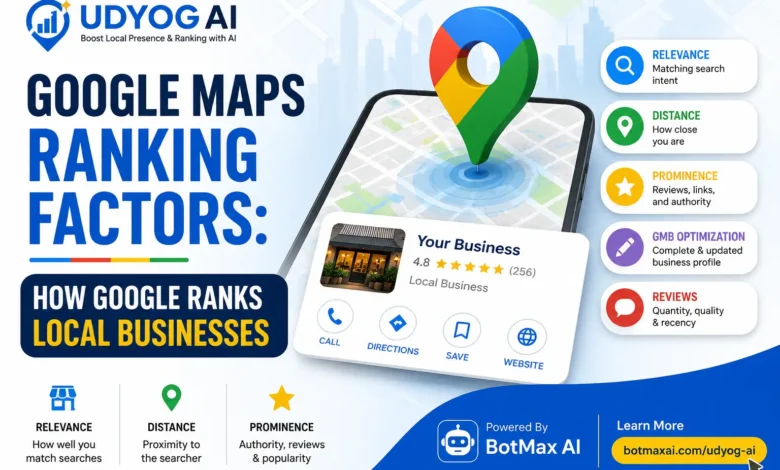
The good news is that Google has publicly shared the three primary factors that influence local rankings:
- Relevance
- Distance
- Prominence
Every local SEO activity ultimately improves one or more of these three factors.
In this guide, we’ll break down the most important Google Maps ranking factors and explain how businesses can improve their visibility in local search results.
How Google Maps Ranking Works
Google Maps rankings are not based on a single metric.
Instead, Google evaluates hundreds of signals to determine which businesses deserve to appear for a particular search query.
These signals are grouped into three major categories:
1. Relevance
Relevance refers to how well your business matches what the customer is searching for.
For example, if someone searches for:
- Dental clinic near me
- Emergency dentist in Lucknow
- Teeth whitening services
Google tries to identify businesses that clearly provide those services.
The more information Google has about your business, the easier it becomes to determine whether your business is relevant to a search.
Factors that improve relevance include:
- Business categories
- Services
- Products
- Business description
- Website content
- Reviews
- Posts
- Photos and videos
Businesses with complete and well-optimized profiles generally perform better because Google understands them better.
2. Distance
Distance measures how close your business is to the customer or to the location specified in the search.
For example:
- “Coffee shop near me”
- “Lawyer in Noida”
- “Salon in Gomti Nagar”
A business located closer to the searcher will often have an advantage.
Unlike other ranking factors, distance cannot be directly controlled.
However, businesses can improve local relevance by:
- Defining service areas correctly.
- Creating location-specific pages on their website.
- Building authority in nearby areas.
- Collecting reviews from customers across their service region.
3. Prominence
Prominence refers to how popular, trusted, and authoritative Google considers your business.
This is often the factor that separates businesses ranking in the top three positions from businesses ranking on the second page of Maps results.
Google may evaluate signals such as:
- Number of reviews
- Review quality
- Review recency
- Website authority
- Local backlinks
- Citations
- Business activity
- Brand mentions
- Customer engagement
A business with hundreds of genuine reviews, regular updates, and strong local authority signals will usually outperform an inactive competitor.
The Most Important Google Maps Ranking Factors
Although Google uses hundreds of signals, local SEO experts generally group them into several major categories:
- Google Business Profile signals
- Review signals
- Website SEO signals
- Citation signals
- Backlink signals
- Engagement signals
- Behavioral signals
Let’s explore each factor in detail.
1. Google Business Profile Signals
Your Google Business Profile is the single most important asset for local rankings.
In many industries, businesses with weaker websites still outperform competitors simply because they have a better optimized Google Business Profile.
Google Business Profile signals include:
- Verification status
- Category selection
- Profile completeness
- Services and products
- Photos and videos
- Business hours
- Attributes
- Posts
- Business activity
The stronger your profile, the easier it becomes for Google to understand and trust your business.
Business Verification
Verification is the first step toward local visibility.
Unverified profiles generally have limited visibility and reduced trust signals.
Verification confirms:
- Your business exists.
- You operate at the listed location.
- You are authorized to manage the profile.
Verification alone will not improve rankings significantly, but it provides the foundation for all future optimization efforts.
Primary Category Selection
Your primary category is one of the strongest ranking signals in local SEO.
Google uses your primary category to determine which searches your business should appear for.
For example:
Poor category selection:
Business: Dental Implant Center
Primary Category: Doctor
Better category selection:
Business: Dental Implant Center
Primary Category: Dental Clinic
The more accurately your primary category matches customer intent, the better your chances of ranking for relevant searches.
Secondary Categories
Secondary categories help Google understand additional services your business provides.
For example, a dental clinic might add:
- Cosmetic Dentist
- Orthodontist
- Emergency Dental Service
- Pediatric Dentist
These categories increase the number of search queries for which your business can appear.
However, avoid adding irrelevant categories simply to increase visibility.
Relevance is more important than quantity.
Profile Completeness
Incomplete profiles almost always underperform complete profiles.
Businesses should complete:
- Business description
- Services
- Products
- Appointment links
- Website URL
- Phone number
- Service areas
- Attributes
- Business hours
- Special holiday hours
Every additional piece of information helps Google better understand your business.
A complete profile also improves customer trust and conversion rates.
Services and Products
Many businesses ignore the services and products sections.
This is a mistake.
Adding services and products helps Google associate your business with specific search terms.
For example, a salon should list:
- Haircut
- Hair Coloring
- Keratin Treatment
- Bridal Makeup
- Facial Services
Similarly, a repair service should list:
- AC Repair
- Refrigerator Repair
- Washing Machine Repair
- Installation Services
The more specific you are, the stronger your relevance signals become.
Photos and Videos
Visual content has become increasingly important in local SEO.
Businesses with fresh, high-quality media often generate more:
- Calls
- Website clicks
- Direction requests
- Profile interactions
Recommended uploads include:
- Exterior photos
- Interior photos
- Team photos
- Product photos
- Service photos
- Before-and-after examples
- Short videos
Regular uploads also signal that the business is active and operational.
2. Review Signals
Reviews are one of the strongest and most visible Google Maps ranking factors.
In many industries, reviews are often the deciding factor between businesses competing for the same position in the Local 3-Pack.
Two businesses may have similar websites, categories, and services, but the business with stronger review signals often wins.
Google evaluates several review-related signals.
Review Quantity
The total number of reviews acts as a trust signal.
A business with 250 genuine reviews generally appears more established than a competitor with only 15 reviews.
However, there is no magic number.
The right benchmark depends on your market and industry.
For example:
- A local bakery in a small town may rank well with 50 reviews.
- A dental clinic in Mumbai may require 500+ reviews to compete effectively.
- A real estate consultant in Delhi may need thousands of reviews to dominate competitive searches.
The goal is not to beat every business in the country.
The goal is to outperform competitors in your local market.
Review Quality
Google does not only count reviews.
It also evaluates their quality.
Detailed reviews provide significantly more context than short generic reviews.
Example:
Weak review:
Great service.
Strong review:
Excellent AC repair service in Gomti Nagar. The technician arrived on time and fixed the cooling issue within an hour.
The second review helps Google understand:
- Service provided
- Business category
- Geographic relevance
- Customer satisfaction
Natural keyword mentions in customer reviews strengthen relevance signals.
Review Recency
A business that received 200 reviews three years ago but none in the last six months may appear less active than a competitor consistently receiving reviews every week.
Fresh reviews indicate:
- The business is still active.
- Customers continue using the service.
- Service quality remains consistent.
Businesses should aim for continuous review growth rather than occasional review campaigns.
Review Velocity
Review velocity refers to the speed and consistency at which reviews are generated.
Example:
Business A:
- 100 reviews received in one week.
- No reviews for the next eight months.
Business B:
- 10 reviews every month for ten months.
Google generally prefers natural and consistent growth patterns.
Steady review acquisition looks more authentic than sudden spikes.
Review Responses
Many businesses focus on collecting reviews but ignore responding to them.
Replying to reviews provides several benefits:
- Signals profile activity.
- Improves customer trust.
- Encourages future reviews.
- Increases engagement.
Businesses should respond to:
- Positive reviews
- Neutral reviews
- Negative reviews
Professional responses demonstrate credibility and customer care.
Average Rating
Although ratings alone do not determine rankings, they strongly influence click-through rates and conversions.
Most customers compare:
- 4.8 stars
- 4.6 stars
- 4.2 stars
A higher rating often results in:
- More clicks
- More calls
- More website visits
- More direction requests
These engagement signals can indirectly support local rankings.
3. Website SEO Signals
Google Maps rankings are heavily influenced by your website.
Many business owners assume that Google Business Profile alone determines rankings.
In reality, your website acts as an important trust and authority signal.
A strong website often improves both traditional SEO rankings and Google Maps rankings.
Local Landing Pages
Businesses serving multiple areas should create dedicated location pages.
Example:
Instead of:
- Services
Create:
- AC Repair in Lucknow
- AC Repair in Gomti Nagar
- AC Repair in Indira Nagar
- AC Repair in Aliganj
Location-specific pages improve geographic relevance.
Service Pages
Every major service should have its own page.
Example:
Instead of one generic page:
- Services
Create:
- Root Canal Treatment
- Dental Implants
- Teeth Whitening
- Braces Treatment
This improves topical authority and keyword coverage.
NAP Consistency
NAP stands for:
- Name
- Address
- Phone Number
Your website should display identical information to your Google Business Profile.
Even small inconsistencies may reduce trust signals.
Example:
Google Business Profile:
ABC Dental Clinic
Website:
ABC Dental Care Center
This creates ambiguity for search engines.
Consistency builds confidence.
Local Schema Markup
Schema helps search engines understand your business information.
Useful schema types include:
- LocalBusiness
- Dentist
- Restaurant
- MedicalClinic
- ProfessionalService
Schema can improve search understanding and eligibility for rich results.
Mobile Experience
Most local searches happen on mobile devices.
Examples:
- Restaurant near me
- Pharmacy near me
- Petrol pump near me
A slow website negatively affects:
- User experience
- Bounce rates
- Conversion rates
Important metrics include:
- Loading speed
- Mobile responsiveness
- Click-to-call functionality
- Navigation simplicity
Internal Linking
Internal links help search engines understand page relationships.
Example:
Homepage →
Dental Services →
Dental Implants →
Root Canal Treatment
This strengthens topical authority and improves crawlability.
4. Citation Signals
A citation is any online mention of your business information.
Google uses citations to verify business legitimacy and consistency.
Examples include:
- Business directories
- Industry directories
- Local chambers of commerce
- Trade associations
- Social profiles
Strong citation profiles improve trust signals.
NAP Consistency Across Citations
Your business details should remain identical across all platforms.
Maintain consistency in:
- Business name
- Address
- Phone number
- Website URL
Even small differences can create confusion.
Citation Quality
Quality matters more than quantity.
Examples of strong citations:
- Industry associations
- Local business directories
- Chamber of commerce listings
- Government business directories
Hundreds of low-quality listings provide little value.
5. Local Backlink Signals
Backlinks remain one of the strongest SEO ranking factors.
Local backlinks are particularly powerful for Google Maps SEO because they improve prominence.
Examples include:
- Local news websites
- Event sponsorships
- Local bloggers
- Community organizations
- Industry associations
- Educational institutions
A backlink from a respected local publication often carries more value than multiple generic links.
Local Relevance
A backlink from:
“Lucknow Business Association”
is often more valuable for a Lucknow business than a generic directory from another country.
Geographic relevance matters.
Brand Mentions
Even unlinked mentions may contribute to local authority signals.
Examples:
- News articles
- Interviews
- Community websites
- Business awards
- Local event coverage
Strong brands naturally attract mentions.
6. Engagement Signals
Google pays attention to how users interact with your profile.
Strong engagement often indicates that customers find your listing useful and relevant.
Examples include:
- Phone calls
- Website clicks
- Direction requests
- Photo views
- Messages
- Booking actions
Businesses generating higher engagement often maintain stronger local visibility.
Click-Through Rate
If users consistently choose your listing instead of competitors, Google may interpret this as a positive quality signal.
Improve click-through rates by:
- Maintaining strong ratings.
- Uploading quality photos.
- Writing compelling business descriptions.
- Using accurate categories.
Direction Requests
Businesses receiving frequent direction requests indicate strong local relevance.
This is particularly important for:
- Restaurants
- Clinics
- Retail stores
- Salons
- Hotels
Calls and Messages
Phone calls and customer messages indicate purchase intent.
Profiles generating strong customer interactions often demonstrate higher business value.
7. Behavioral Signals
Behavioral signals are often overlooked but can influence rankings.
Examples include:
- Branded searches
- Repeat customers
- Direct searches for business name
- User engagement history
Example:
Users searching:
“ABC Dental Clinic Lucknow”
send stronger authority signals than generic searches.
Strong brands generate stronger behavioral signals.
Which Google Maps Ranking Factors Matter Most?
Although Google’s algorithm constantly evolves, a practical priority order looks like this:
Tier 1 (Highest Impact)
- Primary category
- Reviews
- Review recency
- Profile completeness
- Website authority
- Local backlinks
Tier 2 (High Impact)
- Secondary categories
- Services and products
- Photos
- Posts
- NAP consistency
- Local citations
Tier 3 (Supporting Signals)
- Engagement metrics
- Direction requests
- Messages
- Click-through rates
- Brand searches
Final Takeaway
Google Maps rankings are ultimately built on three pillars:
- Relevance
- Distance
- Prominence
Distance is mostly outside your control.
The businesses that dominate local search are usually the businesses that continuously improve relevance and prominence through:
- Better optimization
- More reviews
- Stronger websites
- Local authority
- Consistent activity
Google Maps SEO is not a one-time project.
It is an ongoing process of improving trust, authority, and customer experience.
Businesses that commit to long-term optimization are the businesses most likely to dominate local search results in 2026 and beyond.